When three Canadian soldiers encounter a lone German scout, their sense of morality is weighed against their sense of duty.
Five young soldiers in their twenties, on a mission in the Afghan mountains, have been bored for two months. During a day of support, where they bake in the sun, the routine finally breaks...
Ambulances and British troops crossing the Tugela River over the pontoon bridge near Trichardt's Drift, during the British retreat from Spion Kop in the Boer War, 25 January 1900.
While Greece is under German occupation, a group of soldiers starts from Cairo and arrives in Athens to organize the blasting of the bridge at Gorgopotamos.
The film tells the story of the removal of Laguna in the Paraguayan War. The nonlinear storyline starts showing the military visiting the graveyard of heroes of the battle. Then, a flashback shows the hardships they have endured Brazilian forces that strategic withdrawal. It is the first film entirely national historical reenactment with sound in Brazil.
August 1914: wife and mother, woman's first sacrifice is to see her beloved depart for the front. In a city, she works in railway stations,as a waitress or even as a chimney sweep. At the factory, she only interrupts her work to feed her baby. At the country she does the plowing or picks olives. But above all a wife, she brings the soldier "fraternity and tenderness", parcels, love notes and care. She brings flowers to the dead's tombs, and remains ever present in the soldier's heart.
The Resistance, an ancient theme. Almost always approached from a realistic, if not documentary, perspective. Yet memory reworks in a fantastic, sometimes sinister, way all kinds of memories, even dramas. It is from this point of view that first-time director Daniele Gaglianone (34) approached the subject, despite his deep historical knowledge of the period (he has been working with the National Archive of the Resistance for years). In an interior, rather than intimate key: two old men meet by chance the fascist hierarch responsible for a terrible massacre, and they do not know whether to forgive or avenge. The past then mixes with the present, up to a third dimension that becomes a real character, in the finale: the decision made by the two will turn out to be unsuccessful and then, in order not to "die," the old men will build a perverse inner game capable of remedying every pain...
This is the story of the combat soldiers of Company C, Battalion 51 of the Golani Brigade who had fought on Mount Hermon on October 22 1973. After 30 years of silence they return to that night of battle - the conquest of Mount Hermon during the Yom Kippur War. They had not met all those years, and for the first time they put to words the horrors of the night they lost commanders, brothers in arms and a part of themselves as well.
A powerful nation has experimented with a new gas, which does not kill or injure the asphyxiated subjects, only puts them in a lethargic and mystical state. X-70 gas bombs will be dropped by mistake over Nebelux and provoke an unexpected mutation of the population of this friendly little country. (miff.com.au)
The scenes opens by showing the battleships maneuvering for a position. They finally draw up in line of battle and commence firing on the shore batteries. Immense volume of smoke arise from the fleet and from the distance shore. Shots are seen to fall thickly among the vessels and immense bodies of water are thrown up by the explosion of mines.
1943, The Netherlands is under total Nazi occupation. In Amsterdam, Jack, an unassuming accountant, first meets Ina at a birthday party - a 20-year-old beauty from a wealthy diamond manufacturing family who instantly steals his heart. But Jack's pursuit of love will be complicated; he is poor and married to Manja, a flirtatious and mercurial spouse. When the Jews are being deported, the husband, the wife and the lover find themselves at the same concentration camp; actually living in the same barracks. When Jack's wife objects to the "girlfriend" in spite of their unhappy marriage, Jack and Ina resort to writing secret love letters, which sustain them throughout the horrible circumstances of the war.
This film tells the story of a man that lost his wife and children during the mass exodus of Kurds in 1991, He spends all his life searching for them, and one day he hears an announcement on the radio that there is a place showing hundreds of photos of missing people, He decides to go to this place while listening to the radio continuously, He also hears other stories of other people. All the stories are about getting lost and the tragedies that have happened to Kurds.
A Yazidi refugee camp in Iraqi Kurdistan is home tomore than 20,000 refugees, many of whom are victims of terrorist attacks by ISIS. Shilan is a young Kurdish nurse who volunteered to take care of them. Every tent in the camp has a story, and Shilan takes the responsibility of hearing the refugees out, empathising with the pain they are suffering. One day Shilan hears about a tent where a woman is refusing to eat her food or have any sort of contact with the outside. She decides to take action.
Heroes of Pearl Harbor reveal their story of the surprise Japanese attack that blindsided the American people, and rerouted the course of World War II.
The piece, an experiment that begins on the skin, in the skins of a family that spoke in silence about a tropical dictatorship in the 1980s, the dictatorship of a house. The skins whispered silently and their voices were heard in the corners, on the walls, in the cooking pot, on the soupspoon, on the wet beans. As the soldiers marched in the streets, the echo of their footsteps resonated in the walls of the home of a military man’s family, a house where the words were forgotten. With few oral resources, some photographs and some stolen confessions, the director proposes an exploration that goes from the personal to the political through a fictionalized experience of the family story related to the dictatorship of Panama.
The story of 350 American POWs held at a reclusive and secret concentraion camp administered by the Nazi regime.
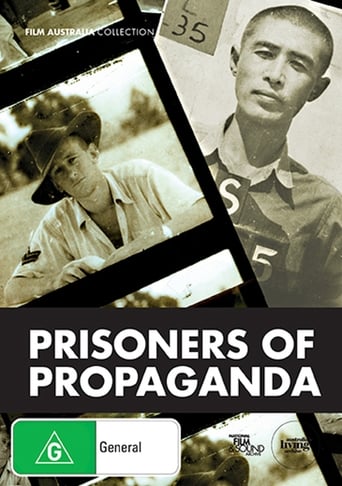
In 1943, the Imperial Japanese Secret Service made a film called Calling Australia! to show the "exemplary conditions" under which prisoners of war were kept, and to "soften up" the Australian public for the anticipated occupation of their country by Japanese forces. Prisoners of Propaganda tells why the film was made, and how it came to be forgotten.
Activate your FREE Account!
You must create an account to continue watching