In Brussels, Belgium, the Royal Museum of Central Africa is undertaking a radical renovation, both physical and ethical, to show with sincerity, crudeness and open-mindedness the reality of the atrocities perpetrated against the inhabitants of the Belgian colonies in Africa, still haunted and traumatized by the ghost of King Leopold II of Belgium, a racist and genocidal tyrant.
When a high-ranking war planner is captured and held in a German prisoner of war camp, a team of specialists take on the dangerous mission of trying to break him out. Trouble is, he doesn't want to be rescued.
On September 19, 2017, at 1:14 p.m., an earthquake devastated Mexico City and its environs. Immediately, citizens mobilized to help, including the actor and youtuber Juanpa Zurita who quickly organized a group of friends that included singers, actors, content creators and other celebrities from the world of entertainment who helped him raise funds for the reconstruction of the city.
Historical epic about the uprising of the Prussians agains the Teutonic crusaders.
The History Channel marks the 20th anniversary of 9/11 with a new groundbreaking documentary about the biggest manhunt in human history. This documentary draws on interviews and stories told in the Museum's special exhibition of the same name, and features interviews with Jan Seidler Ramirez, chief curator and executive vice president of collections, to tell the sweeping tale, linking policy, intelligence, and military decision-making as they converged on a mysterious compound in Abbottabad, Pakistan.
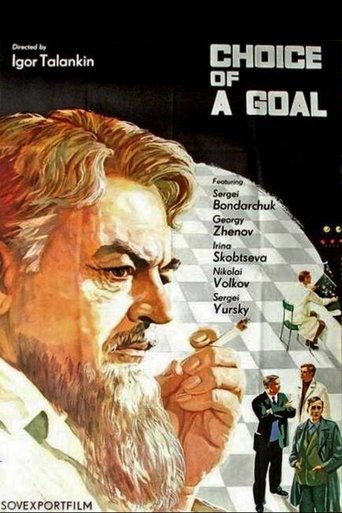
A story of Igor Kurchatov - a father of Soviet nuclear weapons.
The elderly photographer, Chie, told a childhood story about her sister Iòng-Hâ and the sister's admiration Kong-Suī, in a time when Taiwan's cultural and linguistic identity have undergone dramatic changes after the Pacific war.
British explorer Henry Stanley travels to Africa in 1871 seeking missionary David Livingstone.
'JFK: Seven Days That Made a President' investigates the seven key days in JFK's life that helped shape his character and have come to define him.
Madame de Montespan, the Maîtresse-en-titre of Louis XIV, has been in disgrace since the King set eyes on a younger beauty, Marie-Angélique Scorailles. Having had enough of the situation, the rejected mistress decides to visit La Voisin, a woman known as a fortune teller, a doctor, a midwife and who is also said to arrange black masses and sell poisons. Some time later Marie-Angélique, now Duchess of Fontanges, dies mysteriously aged only twenty...
Dance-hall queen Kate Carewe is the toast of the gold-mining camp of Huxley's Gulch. One day a minister, Ralph Bowen, arrives to "clean up" the town. He is scorned by the miners, gamblers and "loose women" of the place, especially Kate, who resents that Bowen calls her a "scarlet woman".
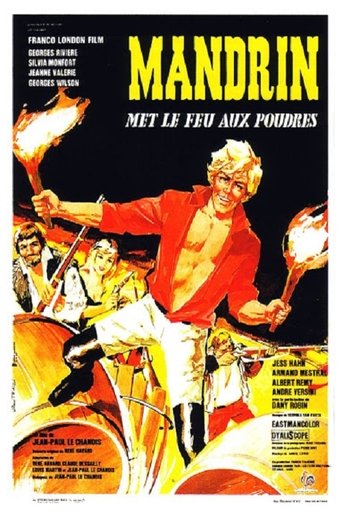
It was the reign of Louis XV and, in 1750, France was at war all the time, and the people, suffocated by taxes, liked their beloved Louis less and less. When the governor of Dauphiné arrived in Saint-Étienne-de-Saint-Geoirs, he had to deal with opponents of the regime who had gathered around cooper Louis Mandrin. Mandrin becomes the vigilante who respects his king, but does not tolerate the oppression of the poor through taxation.
The life of Anthony of Padua (1195-1231) from his arrival on Sicily's shores via shipwreck in 1221 to his death. He's a Portuguese monk who, once in Italy, seeks out St. Francis. Anthony's gift as a great preacher is discovered by happenstance. He spends much of his life in and near Padua, a city run by usurers. Anthony offers protection and friendship to Folco, at one time a petty criminal and acolyte to the usurers, later falsely accused of murder. Anthony's teaching and his spiritual strength lead to changes in the character of Padua and an end to usury. He became its patron Saint soon after his death, and 32 years later, his casket is opened and his tongue remains intact.
The film tells the story of a gang leader who helps in the national struggle. Paşa receives gold from foreign powers in order to neutralize the National Forces. Meanwhile, Captain Murat, gang leader Kuduz Recep, and his men raid Paşa's house. They seize all the gold and set off for Ankara. Kuduz Recep says he cannot continue on the journey because he was wounded in the raid. He takes the gold and flees with his men. Captain Murat pursues Kuduz Recep and his men. Hamza, one of Recep's men, takes advantage of Recep's injury, ties him up, and throws him into the river. He hides the gold and takes over as the leader of the gang. Captain Murat finds Recep in the river and they begin searching for Hamza together. Captain Murat is killed during a clash with Hamza's men. Meanwhile, Recep finds Hamza and takes the gold. He will then set off to transport the gold to Ankara.
Pastor Petrelius does not accept the marriage wishes of his young daughter Karoliina and Paavo Paavalinpoika. Paavo wants to prove his manhood to the pastor and enlists in the King's forces, but is wounded in the Battle of Pultava. On his return to Finland, he finds his village besieged by Cossack Captain Voronoff.
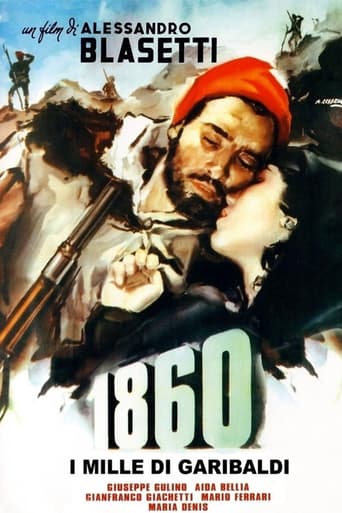
The story is the harried attempt of a Sicilian partisan, as part of the risorgimento, to reach Garibaldi's headquarters in Northern Italy, and to petition the revered revolutionary to rescue part of his besieged land. Along the way, the peasant hero encounters many colorful Italians, differing in class and age, and holding political opinions of every type. There is a key train scene, and the film ends on the battlefield, Italian unification a success, despite brutal losses.
The film focuses on life in a World War II German penal battalion camp somewhere in Russia. The convicts include a heroic doctor unjustly convicted of avoiding military service, an officer who retreated against orders, and common criminals. It shows their life in the camp, clearing mines, living in trenches on the front line.
Activate your FREE Account!
You must create an account to continue watching