Autumn 1941. The Soviet army flees Kyiv, chaos reigns, soldiers attempt to trade their uniforms for civilian clothes in order to escape unnoticed. The war and pending capture of Kyiv by the Germans is the only topic of discussion. Everyone has heard of the horrible things that have happened in other areas, where Jews were brutally and inhumanely murdered. Indecision and despair spread like wildfire among the population. As the German army marches in, fear and horror take over.
With the grand opening of Disneyland just a matter of days away, Walt Disney brings us an update on the construction of the new magic kingdom. Winston Hibler narrates scenes depicting the construction on the attarctions and settings in the park as work speeds up to meet the deadline before opening day.
Falcino, a small town in the south of Italy. No one sees. No one hears. Nobody talks. But everyone knows. And so they all become accomplices of a tragedy against women, against kids, against a family. A story of violence and slavery. Indifference is stronger than their conscience. Maria, a young mother of a family, lives with her husband Gerardo and her two children, Rocco e Carmela, on her father-in-law's farm: "grandpà" Giuseppe. Gerardo decides to emigrate to Austria to earn more money so as to allow a more comfortable life for the family. This absence will be the beginning of a nightmare that will lead Maria and her daughter to be victims of abuse of an unscrupulous ogre (monster).
This is a lyrical TV movie directed by Janusz Kondratiuk and adapted from a W. B Yeats novel. The action takes place in a small medieval village harassed by gang of ruffians. One day, a mysterious knight appears ...
The 1960s in Masuria. Mikołaj Biesaga, seriously injured during the war, swore that if he survived, he would build a chapel to the Blessed Virgin Mary. Years passed, and the "miraculously saved" person did not keep his promise. Now feeling that it is probably time to die, he decides to fulfill his obligations.
From Detroit to Manchester and Boston, countless American towns, streets, and rivers bear French names. But why? Notre rêve américain follows rapper Biz and globe-trotter Jean-Michel Dufaux as they trace the forgotten stories of French Canadians who helped shape American history. Through interviews, archival footage, and on-the-ground exploration, the film uncovers a legacy erased from mainstream narratives — and calls for a renewed connection to this cultural heritage.
Six months after PETA's failure to fight Nippon, Hardo returns to his village in Blora. His presence is smelled by Nippon, tracked and pursued. In a chase one day and night before the proclamation of independence, a drama of struggle is revealed. The betrayal of Hardo's fiance's father is juxtaposed with the betrayal of his best friend Karmin; the resistance of Dipo and Kartiman juxtaposed with Hardo's resistance; the cruelty of the war and the ego of the invaders, a shidokan of Nippon juxtaposed with the deterioration of war victims of Hardo and Ningsih's father.
This short film focuses on the mysterious and legendary Seri Indians who live in a utopian colony off the west coast of Mexico.
Swept up in political unrest during World War I, two sisters in St. Petersburg cope with turbulent romances as Russian history is made around them.
True Story, A Secret to Freedom and Success
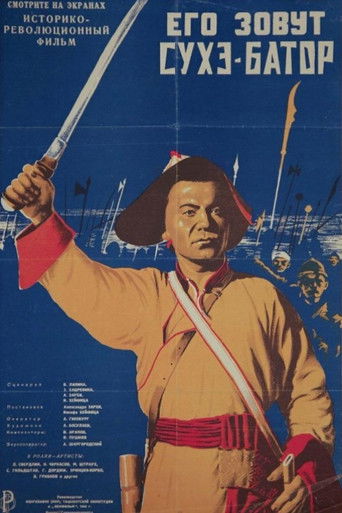
The film tells about the founder of the Mongolian People's Revolutionary Party, the leader of the Mongolian People's Revolution - Damdin Sukhe-Bator.
We live at a moment in time when the Israeli-Palestinian conflict, now more than a century old, continues to be of overwhelming international political and societal importance. From its inception, that conflict has also, of course, had powerful and deeply troubling consequences for Israelis and Palestinians themselves. The story at its most basic level is one that involves two peoples struggling for national recognition and expression in a small but richly significant piece of land. The tragedy of this history, as both the Israeli novelist, Amos Oz, and the Palestinian scholar, Sari Nusseibeh, have each pointed out, stems from a conflict between the rights of two peoples with equal and legitimate aspirations to nationhood and self-expression in a single small territory to which they can both lay claim.
This feature-doc tells the epic story of the Faberge name, from Imperial Russia until the present-day, spanning one hundred and fifty years of turbulent history, romance, artistic development and commercial exploitation. From the bejewel led Easter eggs of the Romanov Tsarinas to the 1970s allure of 'Brut by Faberge' aftershave, and from the Russian revolution to today's high-fashion glitz in New York and London, the film explores a multi-faceted world that began with one man: the prodigiously talented Peter Carl Faberge, Court Jeweler of St Petersburg. Shot at locations across Russia, Europe and USA (including the collection of Her Majesty Queen Elizabeth II), the film features interview contributions from the world's foremost Faberge authorities, as well as personal reminiscences from Faberge family members.
Summer 1942. Nazi troops storm the Caucasus. They are rushing to get their hands on Baku oil. An Abwehr special group called "Wartburg" has settled in the Nalchik area. In Baku, German spy Ziegel (Pavel Kadochnikov) heads to the oil fields from Maykop under the name of Soviet engineer Kashtanov. Tankers carrying gasoline begin to explode in the Caspian Sea. Soviet counterintelligence agent "Khazri" infiltrates "Wartburg"...
Anna Q. Nilsson is the title character, Agnes Lane, a daring spy for the South during the Civil War. She delivers an important message regarding an attack on a Yankee fort, then infiltrates the fort and turns herself in, only to change into a Union soldier’s clothes and escape with more confidential information. The Confederate soldiers love her, and treat her with respect, despite her un-ladylike profession. During the attack, morale appears to flag, but she sneaks out a message that she has been captured by the Yankees and is due to be executed, urging the boys to greater heroism. As they capture the fort, she again infiltrates and pretends to be grateful to her “rescuers.”
1961 - the year when Swedish UN soldiers are in the crisis-ridden Congo and Secretary General Dag Hammarskjöld dies in a plane crash. Swedish film's biggest hit, "Are there angels?", has its premiere with Christina Schollin in one of the roles. Yuri Gagarin becomes the first man in space and the Volvo P 1800 appears on the roads. Ewy Rosqvist is a rally ace and in April the regal ship Vasa is lifted up after 333 years at the bottom of Stockholm's stream. In August, the Berlin Wall is built and outside the Stockholm archipelago, Radio Nord broadcasts music and news.
Pushing the limits of the human race: that is what runners aspire to when they take to the Olympic 100-meter track every four years. But for Usain Bolt, the record holder for the distance with his explosive 9.58 seconds, to become the fastest sprinter in history, crossing the finish line at some 44 km/h, it took more than a century of technical refinement. From the early days of sprinting to Usain Bolt's records, directors Jean-Christophe Rosé and Benoît Heimermann trace the history of the 100 meters, the flagship event of the Olympic Games, and its champions.
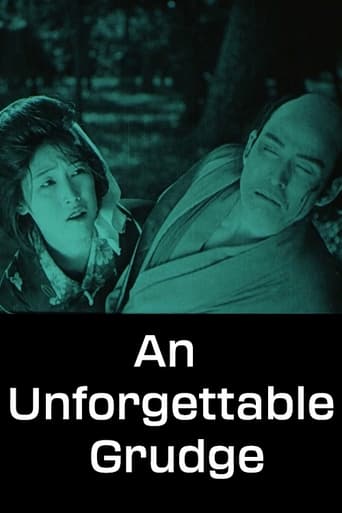
Set in the Edo period, the film deals with two brothers falling in love with the same girl. Sadly, only 12 minutes of footage survive.
Activate your FREE Account!
You must create an account to continue watching