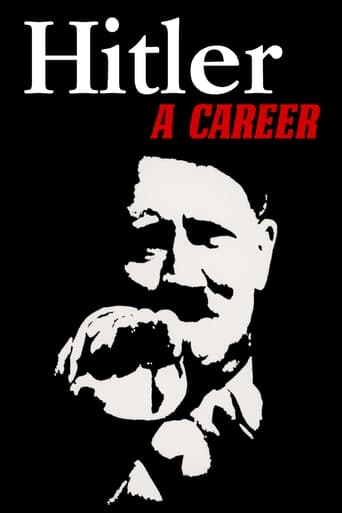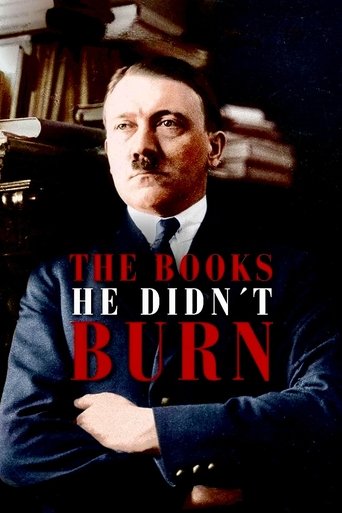
Explores how Hitler’s personal library provides a look into his mind and how it significantly informed his worldview.
A keen chronicle of the unlikely rise to power of Adolf Hitler (1889-1945) and a dissection of the Third Reich (1933-1945), but also an analysis of mass psychology and how the desperate crowd can be deceived and shepherded to the slaughterhouse.
The extraordinary story of how Hollywood changed World War II – and how World War II changed Hollywood, through the interwoven experiences of five legendary filmmakers who went to war to serve their country and bring the truth to the American people: John Ford, William Wyler, John Huston, Frank Capra, and George Stevens. Based on Mark Harris’ best-selling book, “Five Came Back: A Story of Hollywood and the Second World War.”
A Jewish boy separated from his family in the early days of WWII poses as a German orphan and is taken into the heart of the Nazi world as a 'war hero' and eventually becomes a Hitler Youth.
Explores Leni Riefenstahl's artistic legacy and her complex ties to the Nazi regime, juxtaposing her self-portrayal with evidence suggesting awareness of the regime's atrocities.
A victim from World War II's "Death Railway" sets out to find those responsible for his torture. A true story.
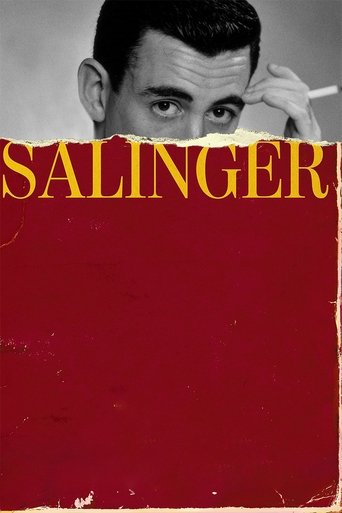
An in-depth investigation into the private world of the American writer J. D. Salinger (1919-2010), who lived most of his life behind the impenetrable wall of a self-imposed seclusion: how his dramatic experiences during World War II influenced his life and work, his relationships with very young women, his obsessive writing methods, his many literary secrets.
The account of keepers of the Warsaw Zoo, Jan and Antonina Zabinski, who helped save hundreds of people and animals during the Nazi invasion.
At the Wannsee Conference on January 20, 1942, senior Nazi officials meet to determine the manner in which the so-called "Final Solution to the Jewish Question" can be best implemented.
In April of 1945, Germany stands at the brink of defeat with the Russian Army closing in from the east and the Allied Expeditionary Force attacking from the west. In Berlin, capital of the Third Reich, Adolf Hitler proclaims that Germany will still achieve victory and orders his generals and advisers to fight to the last man. When the end finally does come, and Hitler lies dead by his own hand, what is left of his military must find a way to end the killing that is the Battle of Berlin, and lay down their arms in surrender.
Inspired by true events from the spring of 1944 when the Nazis organized a football match between a team of camp inmates and an elite Nazi team on Adolf Hitler's birthday. A match the prisoners are determined to win, no matter what happens.
In postwar Germany, an American psychiatrist must determine whether Nazi prisoners are fit to go on trial for war crimes, and finds himself in a complex battle of intellect and ethics with Hermann Göring, Hitler's right-hand man.
The breathtaking story of a man who nearly would have changed the world. In 1939, when Hitler tricked millions of people at the height of his power, radical Georg Elser — disparaged as an assassin — is one of the greatest resistance fighters.
On January 20, 1942, the Wannsee Conference takes place in Berlin, a meeting that had only one item on the agenda: The Final Solution, the organization of the systematic mass murder of eleven million European Jews.
A German Platoon is explored through the brutal fighting of the Battle of Stalingrad. After half of their number is wiped out and they're placed under the command of a sadistic captain, the platoon lieutenant leads his men to desert. The platoon members attempt escape from the city, now surrounded by the Soviet Army.
In 1943, as Hitler continues to wage war across Europe, a group of college students mount an underground resistance movement in Munich. Dedicated expressly to the downfall of the monolithic Third Reich war machine, they call themselves the White Rose. One of its few female members, Sophie Scholl is captured during a dangerous mission to distribute pamphlets on campus with her brother Hans. Unwavering in her convictions and loyalty to the White Rose, her cross-examination by the Gestapo quickly escalates into a searing test of wills as Scholl delivers a passionate call to freedom and personal responsibility.
When Allied forces liberated the Nazi concentration camps in 1944-45, their terrible discoveries were recorded by army and newsreel cameramen, revealing for the first time the full horror of what had happened. Making use of British, Soviet and American footage, the Ministry of Information’s Sidney Bernstein (later founder of Granada Television) aimed to create a documentary that would provide lasting, undeniable evidence of the Nazis’ unspeakable crimes. He commissioned a wealth of British talent, including editor Stewart McAllister, writer and future cabinet minister Richard Crossman – and, as treatment advisor, his friend Alfred Hitchcock. Yet, despite initial support from the British and US Governments, the film was shelved, and only now, 70 years on, has it been restored and completed by Imperial War Museums under its original title "German Concentration Camps Factual Survey".
The history of cinematic sound, told by legendary sound designers and visionary filmmakers.
The film follows Kaspar Hauser, who lived the first seventeen years of his life chained in a tiny cellar with only a toy horse to occupy his time, devoid of all human contact except for a man who wears a black overcoat and top hat who feeds him.
Activate your FREE Account!
You must create an account to continue watching